Why North County San Diego Homeowners Are Installing EV Chargers
San Diego County has one of the highest rates of electric vehicle adoption in the United States, and North County communities like Carlsbad, Encinitas, Del Mar, and Rancho Santa Fe are at the leading edge of that trend. With year-round mild weather, growing public charging infrastructure, and SDG&E’s time-of-use electricity rates, charging at home overnight makes both practical and financial sense for most EV owners.
Level 1 charging from a standard 120V outlet is technically possible, but it adds only 3–5 miles of range per hour — barely enough for a short daily commute and completely impractical for long-range EVs like the Tesla Model 3 Long Range, Rivian R1T, or Ford F-150 Lightning. A properly installed Level 2 home charger changes the equation entirely: plug in after dinner, and you wake up to a full battery.
This guide covers everything North County San Diego homeowners need to know before scheduling an EV charger installation — from choosing the right charger to understanding what the permitting process involves in Carlsbad, Encinitas, Oceanside, Del Mar, San Marcos, Solana Beach, and Rancho Santa Fe.
Level 1 vs. Level 2 vs. DC Fast Charging: Which Is Right for Home?
Level 1 Charging (120V)
Level 1 uses a standard household outlet (NEMA 5-15) and the mobile charging cord included with most EVs. It adds roughly 3–5 miles of range per hour. Level 1 is adequate for plug-in hybrids with small batteries (like a Toyota Prius Prime or Jeep Wrangler 4xe) but is too slow for full battery electric vehicles used daily.
Who it works for: PHEV owners with short commutes who already have a garage outlet. Anyone else should consider Level 2.
Level 2 Charging (240V)
Level 2 uses a dedicated 240V, 40–50 amp circuit — the same voltage class as a clothes dryer or electric range. It delivers 25–40 miles of range per hour, depending on the vehicle’s onboard charger capacity and the circuit amperage. Most homeowners with a full EV will have a full charge by morning regardless of when they plug in.
Level 2 is the right choice for the vast majority of North County San Diego homeowners. It requires a licensed electrician, an electrical permit, and a dedicated circuit — but the investment pays off in convenience within the first week of use.
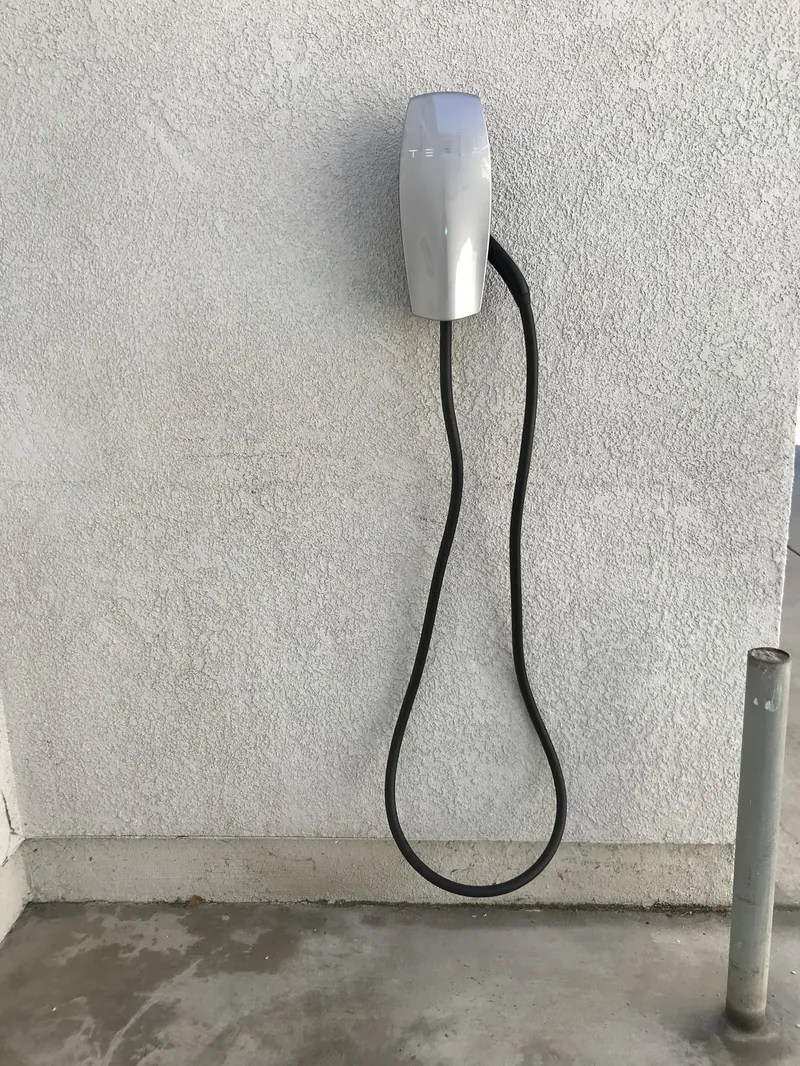
Popular Level 2 chargers: Tesla Wall Connector, ChargePoint Home Flex, Grizzl-E Classic, Emporia Level 2, JuiceBox 48, Wallbox Pulsar Plus.
DC Fast Charging (Level 3)
DC fast charging can add 150–200+ miles of range in 30 minutes. It requires three-phase 480V commercial power and specialized infrastructure that is not practical or cost-effective for residential installation. DC fast chargers are found at public charging networks — Tesla Superchargers, Electrify America, EVgo, and ChargePoint stations.
For home use: Level 2 is the correct choice for nearly all residential applications.
Electrical Requirements for Home EV Charger Installation
Dedicated Circuit
A Level 2 EV charger requires a dedicated 240V circuit — meaning no other outlets or devices share the circuit. The standard is a 40-amp or 50-amp breaker depending on the charger’s maximum amperage draw.
- 40A circuit: Provides up to 32A continuous (NEC allows 80% of rated capacity for continuous loads). Suitable for most EVs and NEMA 14-50 outlet installs.
- 50A circuit: Provides up to 40A continuous. Required for maximum charging speed on chargers like the Tesla Wall Connector set to 48A or ChargePoint Home Flex at full power.
Wire Gauge and Conduit
The correct wire gauge depends on circuit amperage and the distance from panel to charger location. Longer runs require larger wire to prevent voltage drop. In most North County San Diego garages, the panel is relatively close to the charger location, but detached garages, long driveways, and estate properties in Rancho Santa Fe often require more substantial conduit runs. A licensed electrician will calculate the correct wire size for your specific installation.
Panel Capacity
Before installing a dedicated EV charger circuit, an electrician should verify that your electrical panel has capacity to support the additional load. Many homes in Carlsbad, Encinitas, and Leucadia that were built in the 1970s–1990s have 100-amp or 150-amp panels. Adding a 40-amp EV charger circuit to a panel that’s already near capacity can cause persistent tripping or require a panel upgrade before proceeding.
Signs your panel may need evaluation before EV charger installation:
- Panel is 100 amps or smaller
- Breakers are doubled up or tangled
- Panel is more than 30 years old
- You frequently trip breakers with normal household use
A 200-amp panel upgrade typically resolves capacity issues and future-proofs the home for additional loads.
The EV Charger Installation Process in North County San Diego
Step 1: Free On-Site Assessment
A licensed electrician visits your home, inspects the electrical panel, evaluates the distance from panel to garage, and discusses your charger brand preferences and vehicle charging needs. This assessment should be free, and it determines whether any panel work is needed before installation.
Step 2: Proposal and Permit Filing
You receive a written, itemized proposal. Once approved, the electrician applies for the required electrical permit with your city’s building department. Every North County San Diego city — Carlsbad, Encinitas, Oceanside, Del Mar, San Marcos, Solana Beach, and Rancho Santa Fe — requires an electrical permit for dedicated circuit installations. A reputable electrician handles this paperwork and you do not need to visit the permit office.
Step 3: Installation
The electrician runs the dedicated circuit from your panel to the charger location, installs conduit where required, mounts the charger to the wall (or installs the NEMA 14-50 outlet), makes all connections, and tests the installation.
Most residential EV charger installations take 3–5 hours assuming the panel has adequate capacity. Panel upgrades add 1–2 days.
Step 4: City Inspection and Final Sign-Off
The building department inspector visits to verify the installation meets code. The electrician should attend the inspection and address any corrections on the spot. Once approved, you receive the final permit card and the charger is ready to use.
HOA and Condo Considerations in North County San Diego
Many North County communities — particularly in Carlsbad, Del Mar, Encinitas Ranch, and Rancho Santa Fe — are HOA-governed. If you live in a condo, townhome, or planned development, check your CC&Rs before scheduling installation.
California AB 1236 requires HOAs to approve EV charger installation applications within 60 days (with some exceptions), and AB 2565 gives renters the right to install EV chargers with landlord approval. An experienced electrician can help you understand what documentation and approval processes apply to your situation.
Common HOA considerations:
- Required equipment list (approved charger brands)
- Insurance documentation requirements
- Conduit routing restrictions (visible vs. concealed)
- Common parking area vs. private garage rules
Rebates and Incentives for EV Charger Installation
SDG&E EV Programs: SDG&E periodically offers rebates and incentive programs for residential EV charger installations. Programs change, so verify current availability at sdge.com before your installation.
Federal Tax Credits: The federal Alternative Fuel Vehicle Refueling Property Credit (Form 8911) may provide a tax credit for residential EV charging equipment. Consult your tax professional for current eligibility.
Vehicle Manufacturer Incentives: Tesla, Ford, GM, and other manufacturers sometimes offer free charger hardware or installation credits. Check your vehicle’s documentation or manufacturer website.
Your electrician should provide all installation documentation — permits, receipts, and photos — that may be required for rebate applications.
Choosing the Right Electrician for EV Charger Installation
For EV charger installation in North County San Diego, look for:
- California Electrical Contractor License — verify at cslb.ca.gov
- Bonded and insured — protects you in the unlikely event of damage or injury
- Local experience — familiarity with Carlsbad, Encinitas, Oceanside, and other city permit offices
- Written proposal — itemized pricing before any work begins
- Permit handling — your electrician should pull the permit, not ask you to handle it
- Warranty on workmanship — ask specifically about the labor warranty
Wheyland Electric has installed EV chargers for Tesla, Rivian, Ford, Chevrolet, BMW, Hyundai, Kia, and other EV brands across North County San Diego since EV adoption began accelerating in the region. We carry California Contractor License #940291 and back all workmanship with a 1-year labor warranty.
For deeper service details, review our EV Charger Installation service page and city-specific scope for EV charger installation in Carlsbad. If your home needs added capacity, see electrical panel upgrades.
Get a free estimate for your EV charger installation — we will assess your panel, recommend the right circuit, and handle everything from permit filing to final inspection.